
From Pitch to Pour to Purchase | We Help Beverage Brands Land in Bars, Restaurants & Retail | Distributor + Customer Strategy + Field Activation | Just Pick Up the Phone.
June 14, 2026
How Jeff Roslund built Dapper Barons into an 88% reorder-rate brand by ignoring almost everything founders are told to chase.
Here's the fantasy version of launching a spirits brand:
Great liquid. Big distributor. National rollout. Exit.
Here's Jeff Roslund's actual version:
Twelve bottle shops in year one. Dropped by his distributor in year three. On-prem business that legally evaporated overnight.
And an 88% reorder rate most brands with ten times his budget would kill for.
Adam ran this one from Chicago because I was flat on my back with vertigo, and it still turned into a master class. Let's get into it.
🎙️ This Week on Drink Up
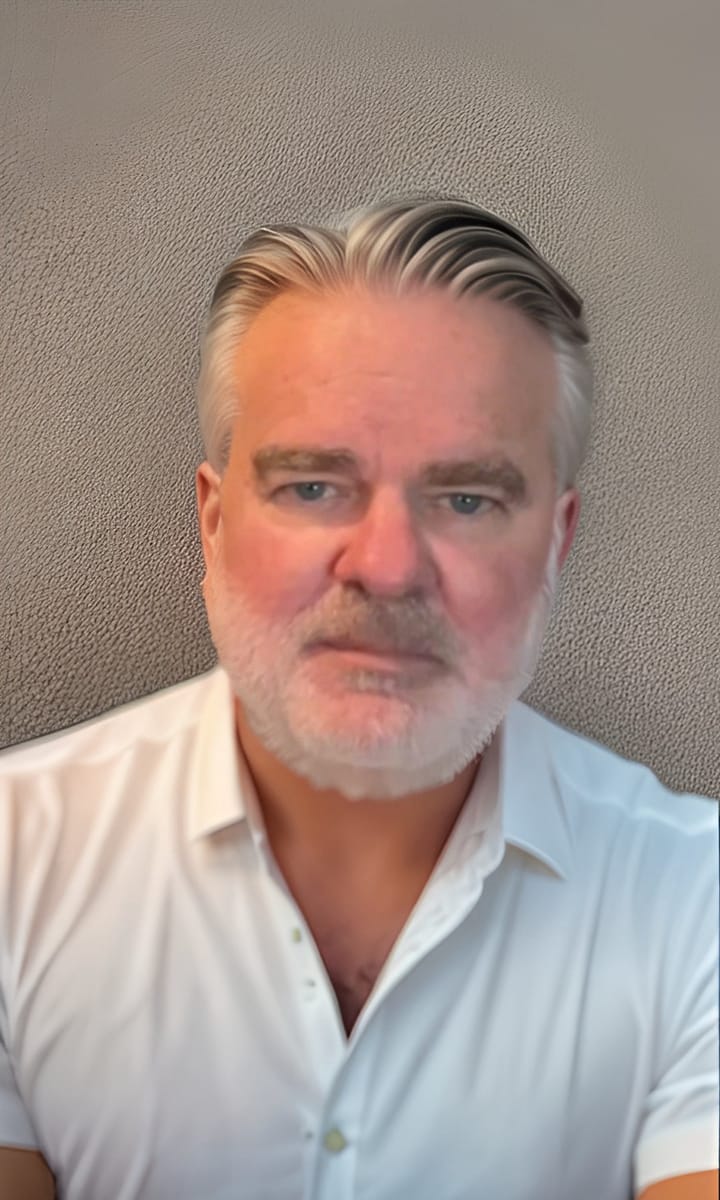
We sat down with Jeff Roslund, founder of Dapper Barons, the low-sugar craft spirits brand he's been building across the Twin Cities since 2021.
He didn't come out of the liquor industry. He came out of a keto diet and a liquor cabinet he started reading the labels on.
He's done all of it with a full-time day job still on his calendar.
That detail matters. Hold onto it.
🧪 The Problem Hiding in Your Liquor Cabinet
Jeff started paying attention to sugar about ten years ago, when he went low-carb. Then he turned the bottle around.
Here is the line that stops every cocktail class he runs cold:
“Standard liqueurs are half a bottle of sugar.”
He brings the visual to prove it.
“Actually it says twelve candy bars.”
Twelve.
Two ounces of that in your morning coffee is the same as eating a Hershey's bar with it.
So he spent COVID with a lab notebook and hundreds of recipes, blending sugar alcohols and plant sweeteners, erythritol, xylitol, allulose, stevia, monk fruit, until he landed a profile with over 90% less sugar than the bottles he was trying to replace.
Industry context: Jeff says 60% of beverages on the market are now sugar-free, that sugar-free went from being the health-nut alternative to being the default. That tracks with everything Circana and NielsenIQ have been showing about better-for-you taking shelf share, and with the no- and low-alcohol category that IWSR has flagged as one of the few growth stories in a flat drinks market.
Sam's take: the better-for-you wave has hit soda, snacks, and seltzer. Spirits is the last room in the house where nobody turned the lights on. Jeff walked in first.
🛒 Twelve Stores in Year One (and Why That's a Win)
Jeff got real with us about the timeline, which is the whole reason I wanted him on.
Year one, September 2021: about a dozen bottle shops. By 2023: 30 to 40 accounts.
Most founders hear that and wince. They shouldn't.
You know how many accounts Jim Koch landed in Boston his first year with Boston Beer?
Thirty.
Sam's take: founders walk into Frontline and tell me they want to be in a thousand stores this year. First of all, you can't afford it. Second, you can't service it. Jeff's twelve real, working accounts are worth more than a thousand placements you can't support. The failure rate in year one is around 95%. He's still here. That is the headline.
💥 The Distributor Breakup Nobody Warns You About
September 2023. His first distributor, Libation Project, called.
“Hey, we're cutting brands, and you're cut.”
It happens to almost everyone. Distributors look at slow-moving inventory on a 365-day clock and they make a cold decision. No offense to the brand, it's just math.
Here's the part that actually hurt, and the part founders never see coming:
“I legally couldn't sell to them for a while. It just kind of evaporated a bunch of, basically all our on-prem business.”
Months of hard-won bar and restaurant accounts, gone in the handoff gap. Nothing he could do about it.
So how did he get a new distributor when distributors don't grow on trees? He didn't chase them. His retailers did it for him.
Haskell's and Lund's vouched for him and pointed him to Bourget Imports, a wine distributor leaning into spirits whose office happened to be a mile from his house. From there he doubled the footprint to about 100 stores across Minnesota. He's since moved again, to Maverick, over a fit conversation.
Adam said: this is exactly the kind of conversation I want to force my clients to watch, middle-school-film-day style. Distributors are going to break up with you. That's okay. Slow and steady, the stuff that's going to happen is going to happen. The brands that survive treat the breakup as a fit problem, not a death sentence.
Sam's take: write this down. When your own retail accounts will pick up the phone and recruit a distributor for you, that is the only distribution pitch that has ever worked. Pull beats push. Every single time.
📊 The 88% Number
I asked Jeff for the one metric he watches. He didn't hesitate.
“Eighty-eight percent of those bottles sold were reorders into existing accounts.”
88%.
That is not distribution. That is demand.
And it's the opposite of the trap most brands fall into. He said it better than I could:
“It's almost like a pyramid scheme. You spend a lot of money up front, you get a lot of placements, but if you don't have that pull through, that product eventually gets moved to clearance, it gets dumped.”
Industry context: Suppliers used to ask us at Breakthrough two questions: how many accounts do you call on, and how many Tito's accounts do you sell to. Then they'd announce they wanted to be in 80% of Tito's accounts. Tito's spent years and a war chest earning that footprint. A small brand chasing it on day one is buying ghost distribution: bottles sitting on back bars, never poured, never reordered.
Sam's take: a bottle in the back bar that never gets poured does nothing for your brand. Jeff's 100 stores are 100 stores that reorder. I'll take that over 1,000 ghost placements and a clearance bin every day of the week.
⚙️ The Michigan Trap
Jeff is from Michigan, so he tried his home turf. Control states sound like a cheat code: register once, roughly 30 days, and anyone can buy your product. Zero barriers to entry.
Then reality showed up.
“You get zero propulsion from your distributor. You are driving 100% of it.”
In Michigan the three distributors only do logistics. RNDC is his, but it's logistics only. The selling runs through brokerage firms on state-mandated margins, so if you want attention you pay on top of everyone else paying the same cut.
And then the killer detail, the one that should be taught in every CPG class:
“There are zero volume discounts and zero delivery fees. So if I'm a liquor store owner, I have zero incentive to buy any volume. I buy one bottle at a time.”
One bottle. Sells. Buy one more. It shows up in a few days. Shelves with thousands of products, one bottle deep on each.
So your entire upside from a store visit is a single bottle on a single shelf.
Sam's take: founders fantasize about control states because the door is open. Jeff just showed you the room behind the door is empty unless you furnish it yourself. Open access and easy growth are not the same thing.
🎯 The Pre-Order Hack (steal this one)
This is the part of the episode I'd pay for. It's the most repeatable go-to-market move I've heard from a small brand in a long time.
Jeff calls his edge liquid to lips. Nothing beats getting the product in someone's mouth. So he built a curated list of every sampling event in Minnesota: Taste of Maple Grove, Taste of White Bear Lake, Shriner's fundraisers, food and wine fests. Most of them are free.
“There's not a list like this out there. You can try ChatGPT, it won't find them either.”
I loved that line so much I had to say it on air: that was all human-to-human combat.
Then comes the move. At each event he hands people a sheet:
“I will buy this product from this store. And I'll give you those papers afterwards. Would you then carry products?”
He walks those signed commitments into the nearby liquor store. Conversion rate?
“At least eighty percent.”
He calls it the pre-order program. He even adds a discount to push sign-ups, and the stores started asking him when the next event is. Then the framing flips entirely:
“It's a privilege to be part of our pre-order program.”
Read that again. He turned a cold retail pitch into a thing stores compete to be chosen for. He doesn't walk in asking for shelf space. He walks in with thirty buyers already holding their wallets.
Sam's take: every other rep walks in and says please carry my product. Jeff walks in and says I have thirty customers ready to buy it from you this week. Those are not the same conversation, and only one of them ends in a PO.
🔥 Hot Take: Your Store Doesn't Care About Your Product
Jeff said the quiet part out loud, and it's the most useful thing in the whole episode.
“I don't care if you're selling zero sugar espresso martinis or full sugar pickle juice, watermelon spritz, whatever. If you think it's gonna sell and you're gonna do all that hard work for me and all I have to do is take orders, then fine, I'll do it.”
Your margin story, your medals, your mission, the store will nod politely. What moves them is the belief that you will create the demand and they just have to ring it up.
Sam's take: stop pitching your liquid. Start pitching the work you're going to do to sell it. The product is table stakes. The pull-through plan is the actual product you're selling to a retailer.
👀 Reality Check: Do the Math on Touch Points
Adam has been preaching this for nine years, and Jeff handed him the cleanest framing he's ever heard for it.
Adam said: if I could lock a buyer in a room for one hour and walk them through the data, I'd probably close them in a single shot. But nobody has an hour to give anybody anymore. So I have to get an hour's worth of time in thirty to sixty second increments, and do the math on how many visits that has to be.
Then the part every founder who rushes a sale needs tattooed somewhere:
Adam said: once I've talked to them for a cumulative sixty, ninety, a hundred and twenty minutes, then you can get up my ass about why the sale hasn't closed. But after one three-minute conversation, we haven't hit the threshold. It's going to take multiple instances.
Jeff's own numbers back it up. On-premise:
“I've been talking to them for like a year before they buy, and it's probably three to ten interactions.”
A year. Three to ten touches. Plus the timing of menu changes, which you don't control.
Sam's take: when a brand asks why a deal hasn't closed after one visit, this is my answer now. You haven't earned the close. You've barely earned the second meeting.
🧠 The First-Mover Disadvantage
You'd think less sugar would sell itself. Adam asked the obvious question: how could it not? Jeff's answer was honest.
First, people hear zero sugar and brace for a Diet Coke compromise on taste. He overcomes that fast with one word: taste it. The medals help too, his products have won at spirits competitions.
Second, and harder, the newness itself reads as a verdict:
“Because it's not out there already, people assume it's because people don't want this. And that's not true.”
That's the first-mover disadvantage nobody mentions. Being early gets read as being wrong. And his theory on why the big guys load up on sugar in the first place is brutal and correct:
“Sugar is basically free. The more sugar and water you can pack into a bottle, you're just getting more margin out of that.”
⏱️ The Full-Time Founder Math
Remember that day-job detail? Here's why it matters.
Jeff puts at least 20 hours a week into Dapper Barons on top of a full-time job, and it actually dovetails: his day job is heavy early in the week, the events stack up Thursday through the weekend.
Sam's take: there are 162 hours in a week. You give your employer 40 to 60 of them. There is a mountain of time left to build the dream, and Jeff is proof you can do it without burning the boat on day one. I went all in working 80 to 120 hour weeks for the man and barely sleeping. Jeff's model is smarter. Stay loyal to the paycheck, deliver on it, and build on the margins until the brand earns the leap.
🎯 The One Idea You Should Steal
If you take one thing from Jeff, take this: demand is something you manufacture in person, then carry to the gatekeeper as proof.
Free event. Liquid to lips. Signed pre-orders. Walk them into the store. Let the store be the hero who fills an order that already exists.
👉 Don't ask for the shelf. Show up with the customers who'll empty it.
🧭 What This Means For You
If you're building a beverage brand right now:
Stop counting placements. Start counting reorders. One number tells you about ego, the other tells you about a business.
Treat a distributor split as a fit problem and let your best retailers introduce the next one.
Map the free sampling events in your market yourself, because no tool will do it for you.
And do the math on touch points before you panic about a slow close.
👉 Patience and persistence aren't soft skills in this industry. They're the strategy.
💬 Final Thought
We ask every guest the same closing question: what's the difference between success and failure? Jeff's answer:
“Success is meeting the expectations you set for yourself. You only fail if you stop learning.”
He's been fired by a distributor, locked out of his own on-prem accounts, and told over and over that nobody's seen a product like his. He's still here, still pouring, still building, on nights and weekends, around a full-time job.
That's the whole game. Be patient, be persistent, and show up. Distributors will fire you. Customers will delete you. The ones who win are the ones who stay in the fight.
🔗 Sources & Further Reading
🧃 Your Move
If you're building a beverage brand right now:
Don't chase placements.
Don't chase the big distributor.
Don't chase 80% of anybody's accounts.
👉 Chase reorders.
Get the liquid to lips, collect the proof, and let the shelf follow the demand.
Watch the full conversation with Jeff, and come build with us at drinkup.bevassets.com.
Truthfully,
Sam


